Recovery Is the New Workout: The Science of Stress, Repair, and Adaptation

I've noticed something about exercise as I've aged.
The workout itself isn't necessarily harder. I can still challenge myself, build strength, and push through a difficult yoga class or workout.
It's the recovery that has changed.
I notice soreness more. It sometimes lasts longer. And I've become much more aware that what happens between workouts matters almost as much as the workout itself.
Apparently, I'm not the only one paying attention.
Workout recovery has become a wellness category of its own. Cold plunges, infrared saunas, compression boots, massage guns, and red-light therapy all promise to help us recover faster. There are even recovery studios where, for a monthly membership, you can move from one technology to another.
It sounds appealing.
But before deciding which recovery technology is worth paying for, there's a more basic question worth asking:
What is the body actually trying to do when it recovers?
Recovery Isn't Just About Feeling Less Sore
After a difficult workout, a lot is happening.
Energy stores need to be replenished. Muscle tissue needs to repair and remodel. Fluids and electrolytes may need replacing. The cardiovascular and nervous systems need to return toward baseline. And the body has to respond to the stress created by exercise.
Eventually, we want to be able to do it all again.
But here's where recovery gets interesting.
Feeling recovered and being physiologically recovered aren't necessarily the same thing.
A treatment might reduce soreness or stiffness without accelerating every biological process involved in recovery. Another might affect short-term performance without changing how sore we feel.
That doesn't necessarily make either treatment ineffective.
It means we need to be clear about what we're asking it to do.
And nowhere is that distinction more interesting than with inflammation.
The Strange Thing About Inflammation
I've spent years thinking about inflammation largely as something we don't want too much of.
Chronic, persistent inflammation is associated with numerous health problems. And anyone who has experienced an inflammatory condition knows that inflammation certainly doesn't feel beneficial.
Exercise complicates that story.
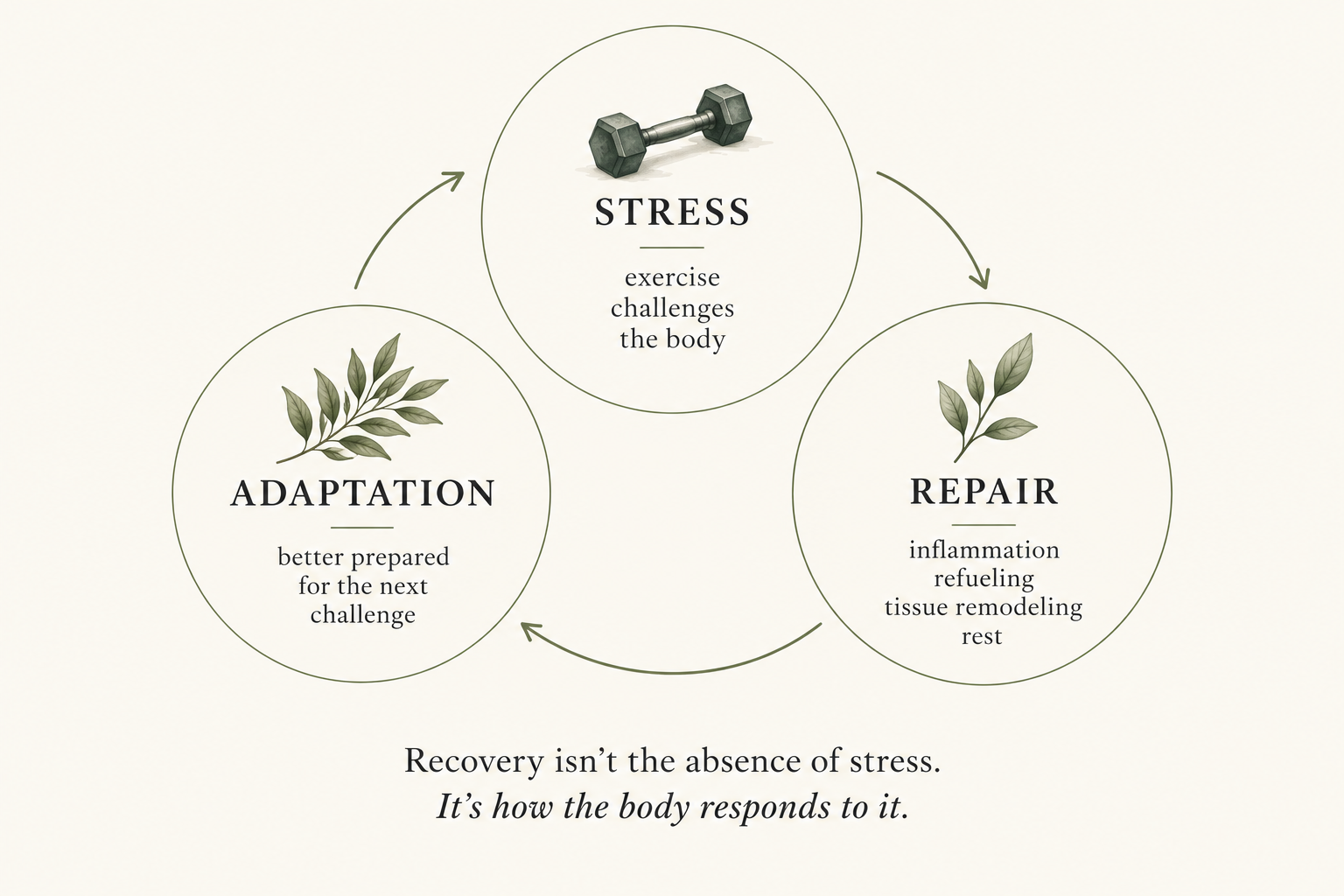
Strenuous or unfamiliar exercise creates physiological stress and can trigger an acute inflammatory response. But that response isn't simply collateral damage. When appropriately regulated, inflammation is involved in muscle repair, regeneration, and adaptation.
In other words, sometimes inflammation isn't evidence that something has gone wrong.
It's part of the body's response to something we deliberately asked it to do.
So perhaps our goal shouldn't always be to eliminate every sign of stress as quickly as possible.
Sometimes the better question is:
What does the body need in order to respond well?
That's Where Cold Plunges Get Interesting
Cold-water immersion is probably the clearest example of why the answer depends on what you're trying to accomplish.
There is reasonably good evidence that cold-water immersion can reduce muscle soreness after strenuous exercise.
If you're an athlete who has to compete again tomorrow—or you're simply very sore and want some relief—that could be useful.
But there's a wrinkle.
Studies of people doing resistance training suggest that routinely using cold-water immersion immediately afterward may attenuate some of the strength adaptations we're exercising to produce. The evidence isn't perfectly uniform, but it's enough to make timing and purpose important considerations.
Which means asking whether cold plunges "work" isn't quite the right question.
Work for what?
To feel less sore tomorrow?
To recover quickly between competitions?
To build as much strength as possible over the next six months?
Those goals aren't necessarily identical.
And the same question is useful when looking at the rest of the recovery aisle.
What About Other Recovery Technologies?
The evidence varies considerably depending on the technology—and sometimes depending on exactly what outcome researchers measure.
Massage guns appear to be useful for things like short-term flexibility, range of motion, stiffness, and some recovery-related outcomes. Evidence that they broadly improve athletic performance is much less convincing.
That may be perfectly fine. If my legs are stiff the morning after a hard workout and a massage gun helps them feel better, improved comfort and movement may be exactly what I'm looking for.
Saunas and heat therapies are particularly interesting because heat isn't simply removing exercise stress. It's another physiological stimulus.
Research into post-exercise heat exposure is growing, but we don't yet have strong evidence that every form of sauna or heat treatment reliably improves recovery or training adaptation. And conventional sauna, hot-water immersion, and infrared sauna shouldn't automatically be treated as interchangeable interventions.
That's a pattern worth noticing.
A recovery technology doesn't have to be either miraculous or useless.
Its effect might simply be more specific—and more modest—than the marketing suggests.
Don't Forget the Boring Recovery Technologies
There is an unfortunate problem with the fundamentals of recovery.
They're difficult to sell.
Sleep isn't new. Neither is eating enough protein, replacing fluids, allowing sufficient time between hard workouts, or adjusting training intensity when your body needs it.
There's no futuristic machine involved.
But those things form the infrastructure that allows recovery to happen.
A cold plunge can't compensate for chronically inadequate sleep. A sauna can't provide the amino acids needed to build muscle tissue. A massage gun can't correct a training program that never gives the body enough time to recover.
That doesn't mean the newer technologies have no value.
It means they should probably be thought of as supporting recovery rather than creating it.
Otherwise, we risk perfecting the garnish while ignoring dinner.
Could a Recovery Membership Actually Be Worth It?

This question interests me because I've started seeing businesses offering exactly that: memberships that provide access to saunas, cold plunges, compression, red-light therapy, and other recovery tools.
At first glance, evaluating the membership seems straightforward.
Do these technologies work?
But I'm not sure that's the most useful question either.
I'd want to know what the membership does for me.
Does it reduce soreness enough that I move more comfortably the next day?
Does having a recovery ritual make me more attentive to what my body needs?
Does feeling better make it easier for me to return to exercise consistently?
And perhaps most importantly:
Would I actually use it?
There's also nothing scientifically illegitimate about valuing something because it feels good.
If spending 30 minutes in a sauna helps me relax after a difficult workout, that experience has value even if I can't demonstrate that my muscles repaired 12 percent faster.
We just need to understand what we're buying.
Sometimes we're buying less soreness or greater range of motion. Sometimes we're buying relaxation or ritual. And sometimes feeling better simply makes it easier to keep doing the behavior that mattered most in the first place:
exercise.
So perhaps the simplest way to navigate the recovery market isn't to ask whether a technology "works."
Ask:
What outcome am I hoping to change?
If the answer is less soreness, one intervention may help. If it's maximizing long-term strength or adaptation, the answer may be different.
And if the goal is simply to feel better, relax, and enjoy taking care of your body?
That counts too.
The important thing is not to confuse one kind of benefit with another.
The Bigger Picture
Recovery isn't the opposite of stress.
It's what allows the body to adapt to stress.
Exercise deliberately challenges the system. Muscle tissue is stressed. Energy is used. Inflammatory and repair processes are activated.
Then the body responds.
The goal isn't necessarily to erase every trace of that stress as quickly as possible. It's to create the conditions that allow the body to repair, adapt, and become capable of handling the next challenge.
That's why the best recovery strategy depends partly on what we're recovering for.
Sometimes we need to recover quickly.
Sometimes we need to let adaptation happen.
And sometimes feeling better is valuable simply because it helps us keep moving.
Recovery isn't doing nothing. It's part of the work.