GLP-1s Beyond Weight Loss: What They Reveal About the Connected Body

A few years ago, the story of GLP-1 medications seemed relatively straightforward.
First, they were diabetes drugs. Then they became weight-loss drugs.
And then something interesting started happening.
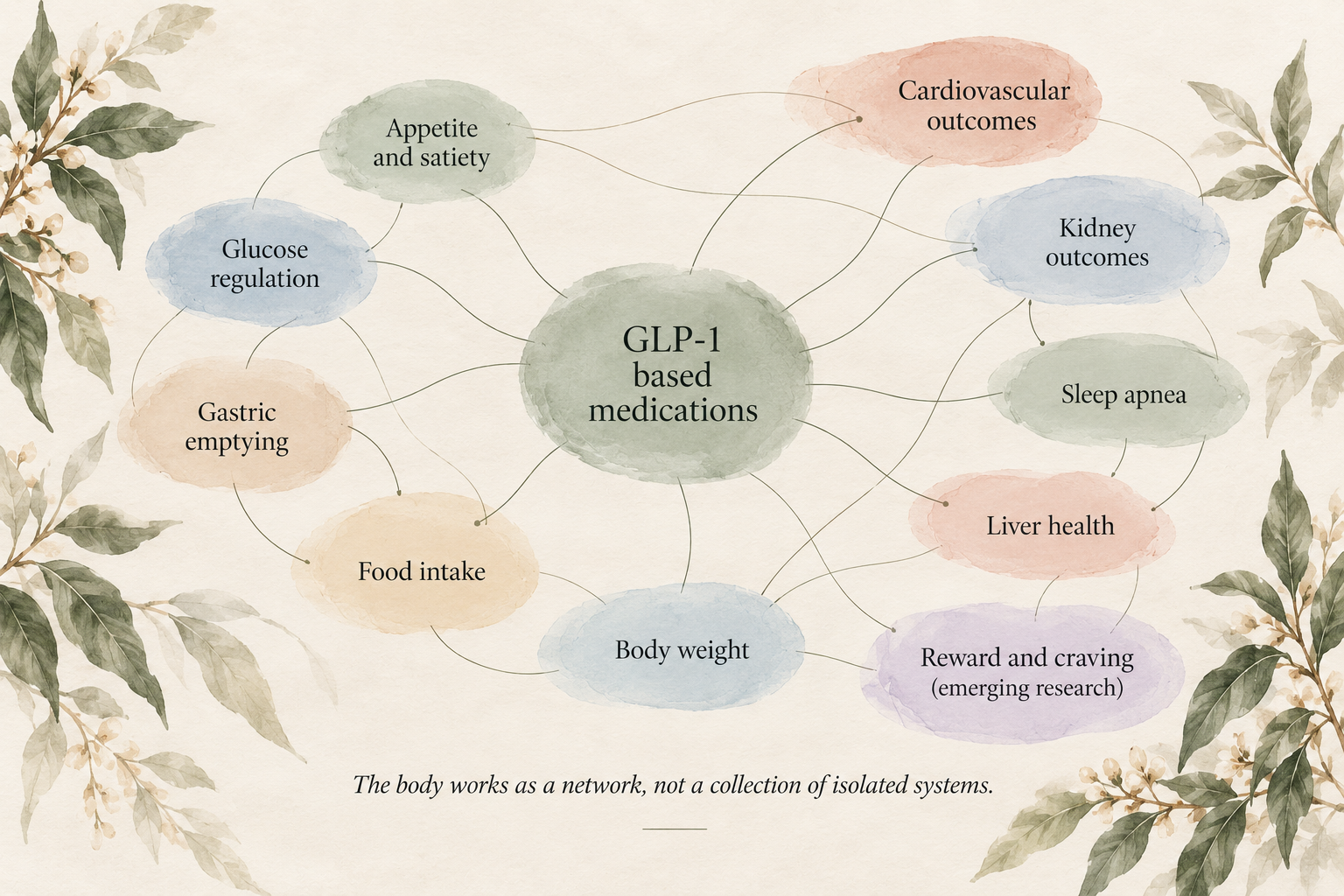
Researchers began finding benefits that seemed to extend well beyond the number on the scale. Cardiovascular events declined. Kidney outcomes improved. Sleep apnea got better. Liver disease improved. Researchers began investigating effects on alcohol use and other behaviors involving reward and craving.
Suddenly, medications known primarily for diabetes and obesity were appearing in conversations about the heart, kidneys, liver, brain, and sleep.
Which raises a fascinating question:
Are GLP-1 medications treating a remarkable collection of different diseases—or are they showing us how connected those diseases were all along?
The Body Doesn't Respect Our Categories
Medicine has good reasons for dividing the body into systems.
We have cardiologists for the heart, endocrinologists for hormones and metabolism, nephrologists for the kidneys, and specialists for the liver, brain, lungs, and sleep.
Diseases get their own names, diagnostic criteria, treatment guidelines, and specialists.
The body is less tidy.
Metabolism affects cardiovascular health. Kidney function is closely connected to blood pressure, diabetes, and cardiovascular disease. Body weight can influence breathing during sleep. Liver health is intertwined with glucose and lipid metabolism. The brain helps regulate hunger and satiety, which influence eating behavior, body weight, and metabolism.
Change one part of this network and effects can ripple through the rest.
GLP-1 medications provide an unusually vivid example of what that looks like.
GLP-1s Don’t Just Change Weight
GLP-1—glucagon-like peptide-1—is a hormone involved in the body's response to food.
Among other things, GLP-1 signaling helps regulate glucose-dependent insulin secretion, slows gastric emptying, and contributes to satiety and appetite regulation through signals involving the gut and brain. Drugs such as semaglutide mimic GLP-1 signaling. Tirzepatide acts on both GLP-1 and another pathway, GIP.
Together, these effects can change glucose regulation, appetite, food intake, and ultimately body weight.
And that can produce substantial weight loss.
But here's where systems-thinking becomes useful.
Losing a significant amount of weight doesn't change only body size and shape.
Blood pressure may fall. Insulin sensitivity may improve. Liver fat may decrease. The mechanical burden on joints changes. Breathing during sleep can improve.
Meanwhile, the medications themselves may have effects that aren't completely explained by weight loss alone.
So what initially looks like one intervention producing one outcome—
drug → biological changes → weight loss → more biological changes
—quickly becomes a much more complicated network.
Except even that is probably too simple.
One Intervention, Many Outcomes
Consider cardiovascular disease.
In a large randomized trial of more than 17,000 adults with established cardiovascular disease and overweight or obesity—but without diabetes—semaglutide reduced major cardiovascular events compared with placebo. That evidence led the FDA to approve Wegovy for reducing the risk of cardiovascular death, heart attack, and stroke in certain adults with cardiovascular disease and overweight or obesity.
That's important because the outcome wasn't simply a lower cholesterol level or another risk factor for cardiovascular disease.
It was fewer serious cardiovascular events.
And cardiovascular disease isn't an isolated example.
Ozempic is now approved to reduce the risk of some kidney disorders.
In 2024, tirzepatide became the first medication approved for sleep apnea.
In 2025, semaglutide was approved as a treatment for MASH, a serious liver disease.
Put those together:
Diabetes.
Obesity.
Cardiovascular disease.
Kidney disease.
Sleep apnea.
Liver disease.
Seen as a list, it can sound as though one class of medications has stumbled upon half a dozen unrelated uses.
Seen as a system, it looks different.
Many of these conditions were never truly unrelated.
So What is Actually Causing the Benefit?
This is where things become scientifically difficult—and much more interesting.
Suppose someone takes a GLP-1 medication, loses substantial weight, has better glucose control, lowers their blood pressure, sleeps better, and ultimately has a lower risk of cardiovascular disease.
What caused what?
Was the cardiovascular benefit caused by weight loss? Better glucose regulation? Lower blood pressure? Changes in metabolic or inflammatory pathways? A direct effect of the medication?
Or, more likely, some combination?
Those aren't trivial distinctions.
And that's part of what makes GLP-1 medications so scientifically interesting.
They're part of the challenge whenever several interconnected risk factors change at the same time.
GLP-1 medications aren't simply giving us new treatments.
They're giving researchers another way to probe the connections between diseases.
What Happens When the Brain is Part of the System?
And then the GLP-1 story gets stranger.
People taking these medications began reporting changes that weren't limited to hunger. Some described less interest in alcohol or changes in other reward-driven behaviors.
Researchers took notice.
In a small randomized clinical trial involving 48 adults with alcohol use disorder, low-dose semaglutide reduced alcohol consumption and craving. The researchers concluded that the findings justify larger clinical trials.
That's fascinating. It is not, however, evidence that semaglutide is an established treatment for alcohol use disorder.
And that distinction matters.
GLP-1 research has generated enormous enthusiasm, which makes it particularly easy for “scientists are investigating this” to become “GLP-1s treat this” by the time a headline reaches us.
Those aren't the same thing.
Possibility is not proof. But sometimes possibility tells us where to look next
Changing the System has Tradeoffs
But interconnected systems work in both directions.
If changing one pathway can produce benefits throughout the body, it can also create effects that require attention elsewhere.
One example is body composition.
When people lose substantial amounts of weight—whether through medication, calorie restriction, surgery, or other means—they generally don't lose only fat.
They can lose lean tissue as well.
A 2026 meta-analysis found that lean mass represented roughly 25–39% of weight lost in trials of incretin-based therapies. Interestingly, the proportion was broadly comparable to that seen with intensive lifestyle-induced weight loss. Lifestyle intervention combined with resistance training had the most favorable lean-mass profile.
That doesn't mean GLP-1 medications uniquely “cause muscle loss.” Significant weight loss from many causes can include loss of lean tissue, and lean mass itself isn't synonymous with essential skeletal muscle.
But it does raise an important question:
How do we lose weight while protecting the things we want to keep?
Especially as we get older, preserving muscle, strength, and physical function matters enormously.
Which brings us back to something considerably less novel than GLP-1 medications:
how we eat and how we move.
The Basics May Matter More, Not Less

There's a strange tendency to talk about medication and lifestyle as though they're competing philosophies.
Either you take a drug.
Or you eat well and exercise.
But biologically, that distinction doesn't make much sense.
If a medication dramatically reduces appetite and someone begins eating much less food, the nutritional quality of what they do eat becomes more important, not less.
These medications also have genuine side effects. Nausea, vomiting, diarrhea, constipation, and other gastrointestinal symptoms are common.
Powerful doesn't mean effortless.
And perhaps the more powerfully we change one part of a biological system, the more attention we need to pay to the rest of it.
The Bigger Picture
I think that's what makes the GLP-1 story so interesting.
It's tempting to see these medications as a technological shortcut around the ordinary work of health.
But I think they reveal almost the opposite.
They show us what happens when we intervene in one part of a deeply interconnected system.
Change appetite, food intake, and glucose regulation, and body weight may change.
Change body weight and metabolism, and effects can ripple outward—to sleep, liver health, cardiovascular risk, kidney health, mobility, and more.
But those same changes can create new considerations around nutrition, muscle, side effects, and long-term care.
The lesson isn't that one pathway controls everything.
It's that nothing in the body happens entirely by itself.
Medicine needs categories. They're how we diagnose disease, conduct research, and organize care.
But sometimes the categories can obscure the connections.
Perhaps the most interesting thing about GLP-1 medications isn't how many conditions they may eventually treat.
It's what they're teaching us about how connected those conditions—and our bodies—have always been.