
Sleep supplements have become increasingly sophisticated.
Melatonin. Magnesium. Glycine. L-theanine. Valerian. Tart cherry.
Then there are powders, capsules, gummies, and nighttime drinks combining several of them into increasingly elaborate formulas.
And unlike some wellness products, the outcome we're looking for is pretty straightforward:
Did I sleep better?
Underneath that simple question, though, is complicated biology.
Someone may struggle to sleep because of circadian timing, stress or mental arousal, hormonal changes, pain, caffeine, medications, environmental factors, or an underlying sleep disorder.
Understanding the cause can help us choose the right solution—and recognize when poor sleep deserves medical attention.
What Actually Has to Happen for Us to Sleep?
Sleep isn't simply what happens when we're tired enough.
Two major biological processes help regulate it.
Sleep pressure builds the longer we're awake, increasing our drive to sleep.
Circadian timing acts more like an internal clock, helping coordinate when the body expects sleep and wakefulness.
But neither operates in isolation.
Light exposure, stress, hormones, body temperature, caffeine, alcohol, medications, illness, pain, and environment can all influence whether sleep comes easily.
That's why "I can't sleep" can describe very different problems.
What Does “Better Sleep” Actually Mean?
Before evaluating a sleep supplement, it helps to define what you're trying to improve.
Do you have trouble:
falling asleep?
staying asleep?
waking too early?
feeling restored the next morning?
They may all leave you tired, but they're not necessarily the same problem.
And a supplement that helps with one may do very little for another.
What Does the Evidence Say About Sleep Supplements?

Melatonin: Helping Tell the Body ‘When’
Melatonin may be the best-known sleep supplement, but it's often misunderstood.
It's a hormone the body produces to help signal biological night—less an "off switch" than a message that it's time for sleep.
That's why timing matters.
Melatonin makes particular sense when circadian timing is part of the problem, such as jet lag or certain delayed sleep schedules. It may also help some people fall asleep a little sooner.
And more isn't necessarily better. A larger signal doesn't automatically create better sleep.
Magnesium: Supporting the Conditions for Sleep
Magnesium participates in hundreds of processes throughout the body, including nervous-system and muscle function.
But the evidence for magnesium supplements specifically improving sleep is more modest than their popularity suggests. Studies have found associations between magnesium status and sleep, while supplementation trials have been less consistent.
It may help some people. It just isn't a universal sleep aid.
L-Theanine: Turning Down the Volume
L-theanine is an amino acid naturally found in tea that appears to promote relaxation without necessarily causing drowsiness.
Recent research suggests benefits for several self-reported sleep measures, including sleep quality and the time it takes to fall asleep.
If mental activity is keeping you awake, turning down the volume may be enough.
Glycine: An Interesting Emerging Option
Small studies suggest glycine may improve subjective sleep quality and how rested people feel the next day.
One proposed mechanism involves helping regulate the drop in core body temperature that normally accompanies sleep.
Promising—but the research base is still small.
Tart Cherry: Food Meets Sleep Supplement
Tart cherry juice and concentrates contain small amounts of melatonin along with other biologically active compounds.
Some studies have reported improvements in sleep duration, efficiency, or the time it takes to fall asleep.
The evidence is still limited, but interesting enough to keep watching.
Valerian: Long History, Mixed Evidence
Valerian root has been used as a sleep remedy for centuries.
Its compounds may influence GABA-related pathways involved in calming nervous-system activity, which gives its traditional use some biological plausibility.
But clinical studies have been inconsistent, and its effectiveness for insomnia remains uncertain.
What About Multi-Ingredient Sleep Formulas?
This is where sleep supplements get especially interesting.
Modern formulas increasingly combine ingredients such as:
Melatonin + magnesium + L-theanine + glycine + botanicals
At first glance, that can look like overkill.
But difficulty sleeping rarely comes from one isolated pathway.
Imagine melatonin reinforcing the body's timing signal while L-theanine reduces mental arousal. Magnesium may support relaxation while glycine helps prepare the body physiologically for sleep.
In that case, the ingredients aren't redundant.
They're doing different jobs toward the same outcome.
Of course, there's another possibility: perhaps one ingredient is doing almost all the work.
If that's true, you could potentially get the same benefit from a simpler—and cheaper—product.
Single Ingredient or Sleep Blend?
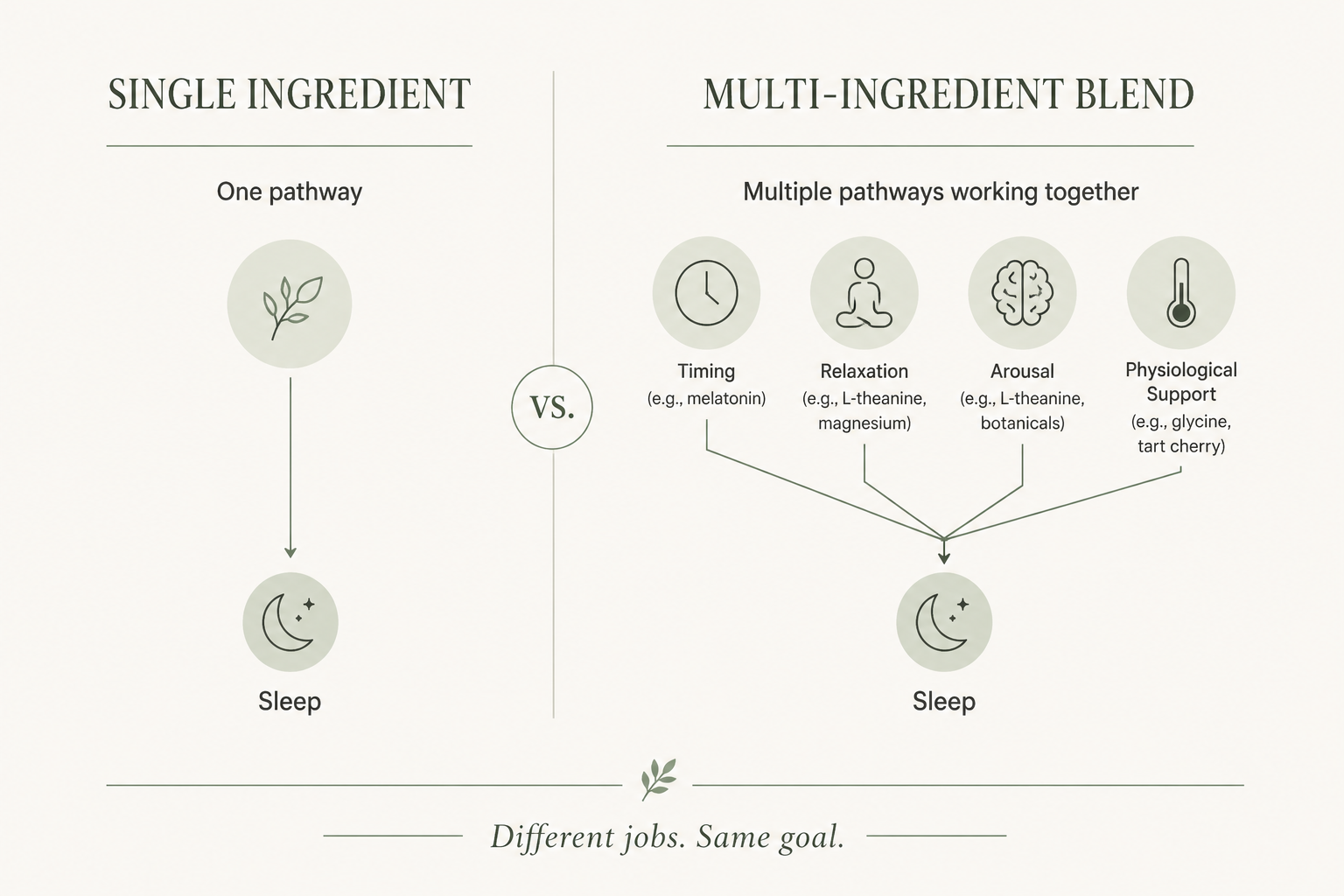
There's a reasonable argument for both.
A single ingredient makes sense when you have a good idea what you're trying to influence. It's generally cheaper, easier to evaluate, and easier to adjust for dose or timing.
A multi-ingredient formula may make sense when several factors could be interfering with sleep—or when you simply want one convenient product that addresses several plausible pathways.
The tradeoff is information.
If you don't know why the formula works and it suddenly stops working, you have very little to troubleshoot. You're essentially back at the beginning.
Understanding the underlying problem gives you more control.
A good blend can simply make that understanding less necessary—when it works.
What Should You Realistically Expect?
Sleep supplements don't have to knock you unconscious to be useful.
Maybe you fall asleep 10 minutes faster.
Maybe you wake less often.
Maybe you wake feeling noticeably better.
A small improvement that happens night after night can add up to something meaningful.
This is also where measurement gets interesting.
A wearable may tell you that your sleep score increased by three points. But if you can't feel any difference in your sleep or how you function the next day, how meaningful is that improvement?
We'll come back to that when we look more closely at sleep tracking and recovery.
Give It a Fair Trial
One of the easiest ways to waste money on wellness products is to use them inconsistently and then realize you have no idea whether they worked.
If you're going to try a sleep supplement, decide what you're hoping will improve.
Then use it consistently enough to evaluate it, and pay attention to both how you sleep and how you feel the next day.
The goal isn't to run your own clinical trial.
It's simply to give yourself a fair chance of answering:
Is this actually helping me?
The Bigger Picture
Sleep depends on many things going right at once.
That's partly why individual sleep supplements can be frustrating: one ingredient may target a pathway that isn't particularly relevant to your problem.
It's also why thoughtfully designed combinations can be useful. Several ingredients can support different processes that all contribute to the same goal.
That doesn't make the underlying cause irrelevant. Persistent sleep problems deserve investigation, and sometimes identifying the cause is the most important thing you can do.
But sometimes the practical questions are enough:
Did I sleep better?
Did I feel better the next day?
And is the benefit worth the cost and effort?

Note: Sleep supplements can cause side effects and interact with medications, and persistent sleep problems can sometimes indicate an underlying sleep or medical disorder. If you're regularly struggling to sleep, experiencing substantial daytime sleepiness, or have symptoms such as loud snoring, choking, or gasping during sleep, talk with your healthcare provider.